
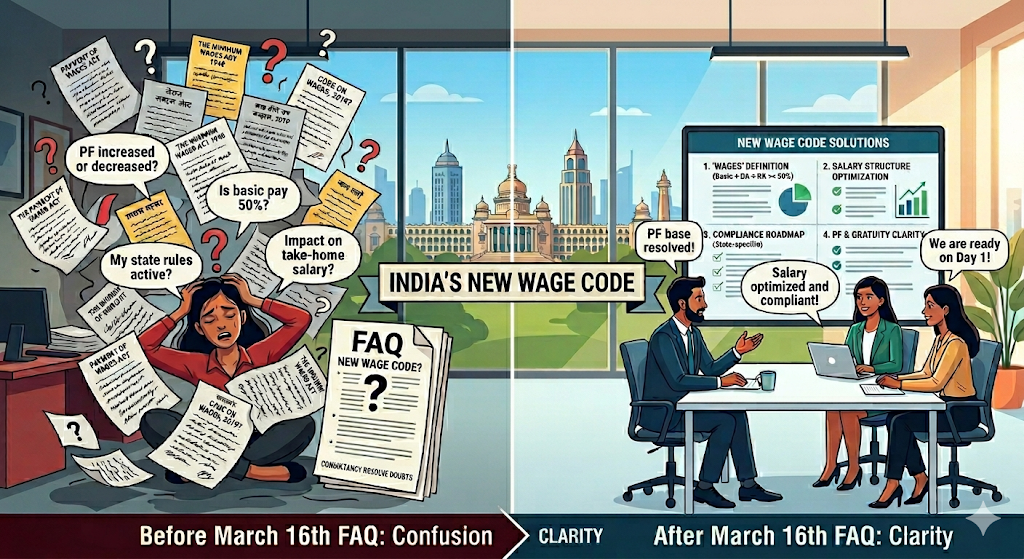
The implementation of the New Labour Codes on November 21, 2025 introduced a unified definition of "Wages." However, the Additional FAQs released by the Ministry of Labour on March 16, 2026 provided the final missing pieces regarding how additional pay components like Overtime, Shift Allowances, and In-Kind benefits impact your statutory bottom line. For HR and Finance teams, the message is clear: if your allowances cross 50% of the total remuneration, your statutory wages go up and so does your cost of compliance.
The Periodicity Filter: Annual vs. Monthly
The new clarification draws a sharp line based on payment frequency:
- Monthly/Quarterly/Non-Annual: Payments like Overtime, Shift Allowances, and Monthly Incentives are "Excluded Components." If these, combined with HRA and other allowances, exceed 50% of the total remuneration, the excess is added back to the Wage base.
- Annual Periodicity: True annual payouts (like an Annual Performance Bonus) are not considered remuneration for the 50% test, keeping your wage base stable.
Scenario A: The Fixed Monthly Remuneration (The Pull-Up Effect)
- In structures where allowances are high to minimize the Basic salary, the 50% rule automatically pulls the wage base upward.
- Monthly CTC: Rs 50,000
- Current Structure: Basic (Rs 20,000) + HRA/Allowances (Rs 30,000).
- The New Math: 50% of Rs 50,000 is Rs 25,000. Since the current Basic is only Rs 20,000, the law forces the Wage base up to Rs 25,000.
- The Impact: Gratuity liability for an employee with 6 years of service jumps from Rs 69,230 to Rs 86,538 - a 25% increase in long-term liability.
Scenario B: High Variable Payouts (The Overtime Shift)
- This is where the March 16th FAQ creates the biggest surprise. Non-annual extra income lowers your Basic-to-Gross ratio in the month it is paid.
- Scenario: Fixed CTC of Rs 50,000 + Overtime (Rs 2,200) + Awards (Rs 5,000).
- Total Monthly Remuneration: Rs 57,200.
- The New Math: 50% of Rs 57,200 = Rs 28,600.
- The Impact: Because the OT and Awards pushed total remuneration up, the Wages for that month must be Rs 28,600. This results in a 43% increase in the statutory base for that period.
Scenario C: The ESI Coverage Trap (The Silent Risk)
- Many employees previously exempt from ESI due to high gross salaries are now falling back into the net.
- Scenario: Monthly CTC of Rs 40,000.
- Old Status: Gross salary was > Rs 21,000, so the employee was Exempt.
- The New Reality: ESI applicability is now tested against the Revised Wages (50% of CTC).
- The Math: 50% of Rs 40,000 = Rs 20,000.
- The Impact: Since Rs 20,000 is below the Rs 21,000 threshold, this employee is now Covered. This reduces take-home pay for the employee and increases overhead for the employer.
Scenario D: The In-Kind Complexity (The Floor vs. The Ceiling)
- The most nuanced change involves Remuneration in Kind (Meal Coupons, Gift Vouchers). Under Section 2(88), these act as a Double-Gate:
- The Floor (15% Rule): In-kind value up to 15% of wages is deemed to be wages.
- The Ceiling (50% Rule): Any excess in-kind value acts as an exclusion that can trigger a further add-back.
The Takeaway: Small in-kind benefits get swallowed into wages directly, while larger ones push your total exclusions closer to the 50% limit, potentially triggering an even higher wage base.
Comparison: The Impact of In-Kind Value on a Rs 25,000 Basic
| Component | In-Kind = Rs 2,500 | In-Kind = Rs 5,250 |
|---|---|---|
| Initial Basic | Rs 25,000 | Rs 25,000 |
| In-Kind Amount | Rs 2,500 | Rs 5,250 |
| Deemed as Wages | Rs 2,500 (Full amount) | Rs 3,750 (Capped at 15%) |
| Remaining Exclusion | Rs 0 | Rs 1,500 (Adds to 50% test) |
| Final Statutory Wage | Rs 27,500 | Rs 28,750 |
Conclusion: Time to Re-Audit Your Structure
The March 16th FAQs make it clear that the Government is prioritizing a Wage-Heavy structure. Relying on high allowances or perks to minimize statutory contributions is no longer a viable strategy.
- Re-simulate Payroll: Run Type B and Type C scenarios to identify hidden ESI and Gratuity costs.
- Review Periodicity: Ensure Annual components are explicitly defined as annual in appointment letters.
- Update Actuarial Provisions: Adjust your Gratuity valuations now to avoid a balance sheet shock at year-end.
Need help with this?
If you want to move from manual excel checks to system driven compliance, EZII Payroll can help you configure the new wage definition, run what if simulations on salary structures, and automate PF, ESI and Gratuity under the 50% rule. Reach out for a consultation on how to implement the New Wage Code seamlessly in your payroll workflows.